

.jpg)
Scroll
In recent years, digitalization has revolutionized the nature and organization of office work; today, also the realization of the technical plants of a building is changing in a profound way. It is the case of the illumination: a control based on the most recent digital technologies is able to offer a performance unthinkable in the past, and takes into account not only the visual, but also the emotional and the biological point of view.
In many cases, lighting can express a new company culture, focusing on people and their needs, thus creating the best work conditions. It is not hard to understand the reasons: employees and their know-how represent the most important asset for a company and, at the same time, the most relevant cost. Those who invest in the health and well-being of their own employees will see the advantages in a surprisingly short time. In fact, a good illumination makes it easier to focus and reduces fatigue, thus increasing well-being and productivity. But it is not limited to that: it also respects the people’s biological rhythm, it regulates according to the personal needs, inspires individual creativity: in short, it contributes to a high-quality environment.
Illumination as a design tool
In a world where most people in the developed countries are employed in activities based on information and knowledge, the office becomes a meeting point, a place to exchange information and ideas, of communication and creativity. A place evolving through time to keep track of the constant organizational changes.
An optimal design of the workplace plays a key role, combining technical, economical and social aspects: illumination is at the center of this process. Light becomes the tool par excellence in designing environments, like furniture or acoustics: it should come as a surprise, because first of all light creates atmosphere.
More possibilities
Traditional lighting systems are characterized by a complete immobility and are not able to fulfill the requirements of functional buildings: devices constantly switched on in unoccupied environments, lights fully on of off without intermediate situations, always the same color temperature of the light sources until their replacement, necessity to modify the wiring in case of space reconfiguration are only a few examples of that.
Only flexible and smart systems can embrace the changes of both work organization and architectonic spaces, adapting through time with the dynamicity that traditional system cannot offer. Light designers can then exploit natural light, adapting in a creative way different tones of light and color, devising lighting scenes and so much more, while owners and managers can take advantage of a more efficient use of energy and offer the best possible conditions to the occupants.

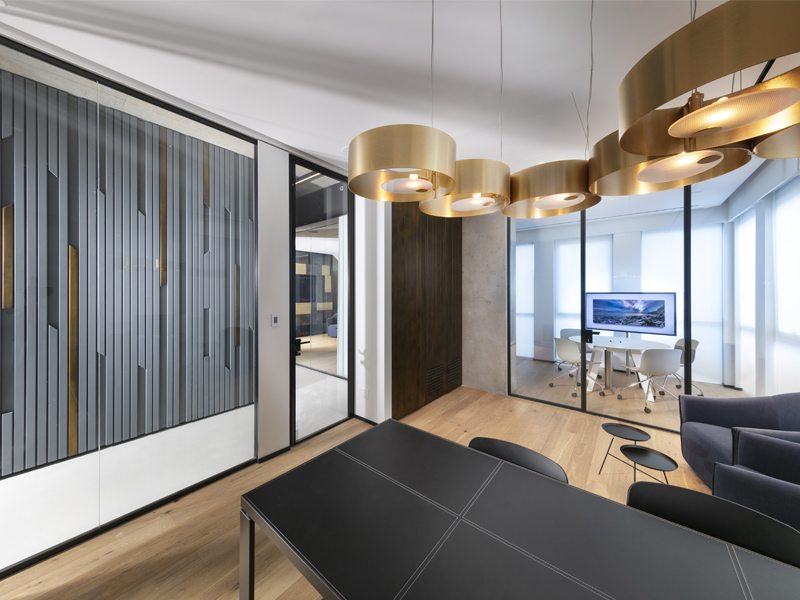
Application example: the meeting room
Meeting rooms are important parts of all offices and company headquarters; a single environment but many possibilities of use such as meetings, presentations, workshops, conferences or trainings.
In meeting rooms, besides illumination there are other functions such as climate and shade control, as well as multimedia technologies; in these cases, flexibility and interoperability of the automation system become key factors.
Coordinated control of multiple functions must be simple and immediately understandable also to people without technical knowledge, without relying on any staff intervention. In these environments, lighting control is particularly important to create an ideal atmosphere for each different situation of use; it must always be comfortable, but also customized based on the current activity. In fact, according to the different moments, it becomes necessary to make the attendees focus or relax, or direct the attention on the speaker or the screen.
Lighting control and monitoring can be carried out by the Delégo supervision; the server EK-DEL-SRV (A) can be connected to a Delégo touch panel (B) installed near the speaker’s pulpit and a mobile device such as a tablet (3). Traditional manual commands can also be used in parallel, like for example a pushbutton (D) to control shades in proximity of doors and windows.
Undimmable lighting devices with actuator EK-FE1-TP (5) or devices equipped with dimmable LED sources (4) can be controlled through the RGBW LED dimmer EK-GC1-TP (C). Moreover, the gateway EK-BG1-TP (G) allows to control DALI dimmers (H, I) and other various devices equipped with DALI digital reactors (11).
Combination of commands and controls can be easily grouped in scenes and recalled with a single touch from the Delégo supervision: this allows, for example, to coordinate the command of the lights (4,5), the projector (9), the screen (6) and the shades (7) in order for the natural light to be allowed in or shielded during the presentation.

| Ekinex devices | Other components |
| A) Delégo server EK-DEL-SRV-... | 1) Switch |
| B) Touch panel Delégo (5” o 8”) | 2) Access point LAN Wi-Fi |
| C) LED dimmer RGBW EK-GC1-TP | 3) Tablet with Delégo home control |
| D) Ekinex pushbutton (Serie 71) | 4) Dimmable LED devices |
| E) Binary output / shutter actuator EK-FE1-TP | 5) Undimmable devices |
| F) Gateway KNX-DALI EK-BG1-TP | 6) Projector screen |
| 7) Shades, shutters, curtains | |
| 8) Motorized window | |
| 9) Projector | |
| 10) Motorized actuator | |
| 11) DALI reactor |
.svg)
 (2).png)
